Part 7
Sailing and Sleeping Aboard.
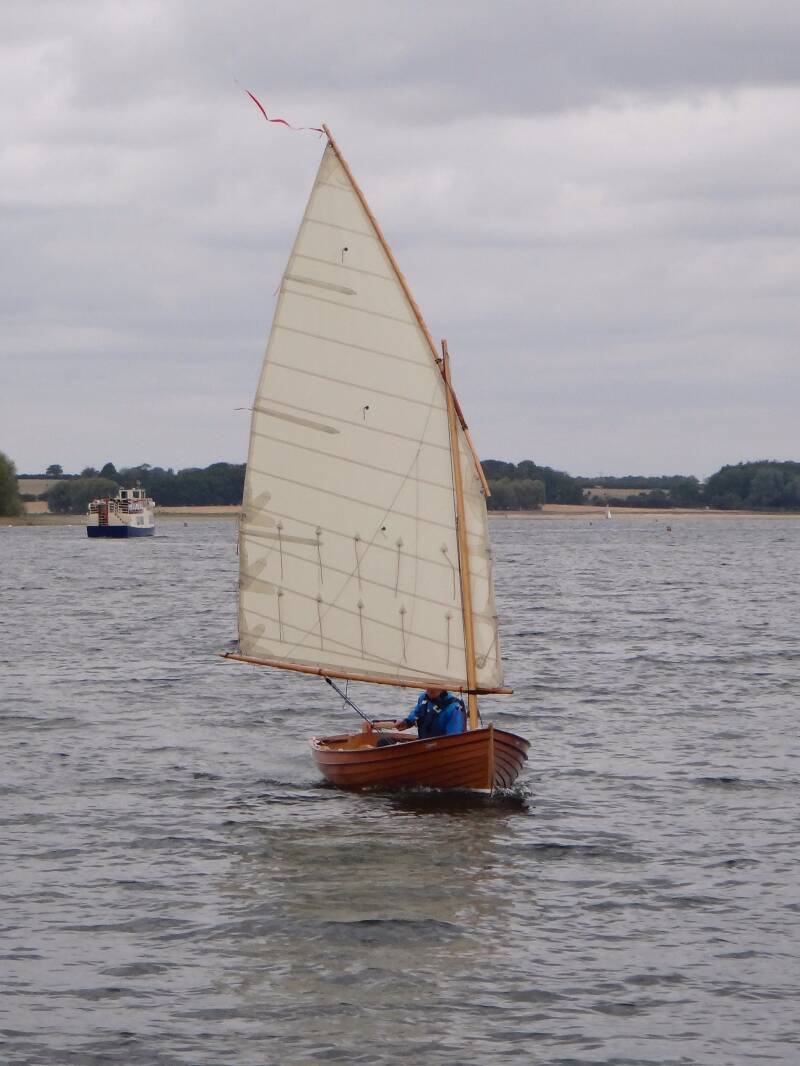
I've now had some more opportunities to sail in Mynewt but there is still much to learn. She seems a stable, forgiving craft, and is relaxing to handle. I have improved the set of the sail, removing the diagonal crease by increasing downhaul tension. At present, in light winds the sail appears very flat, only gaining a good shape when the wind lifts - something to investigate further.

A Tent
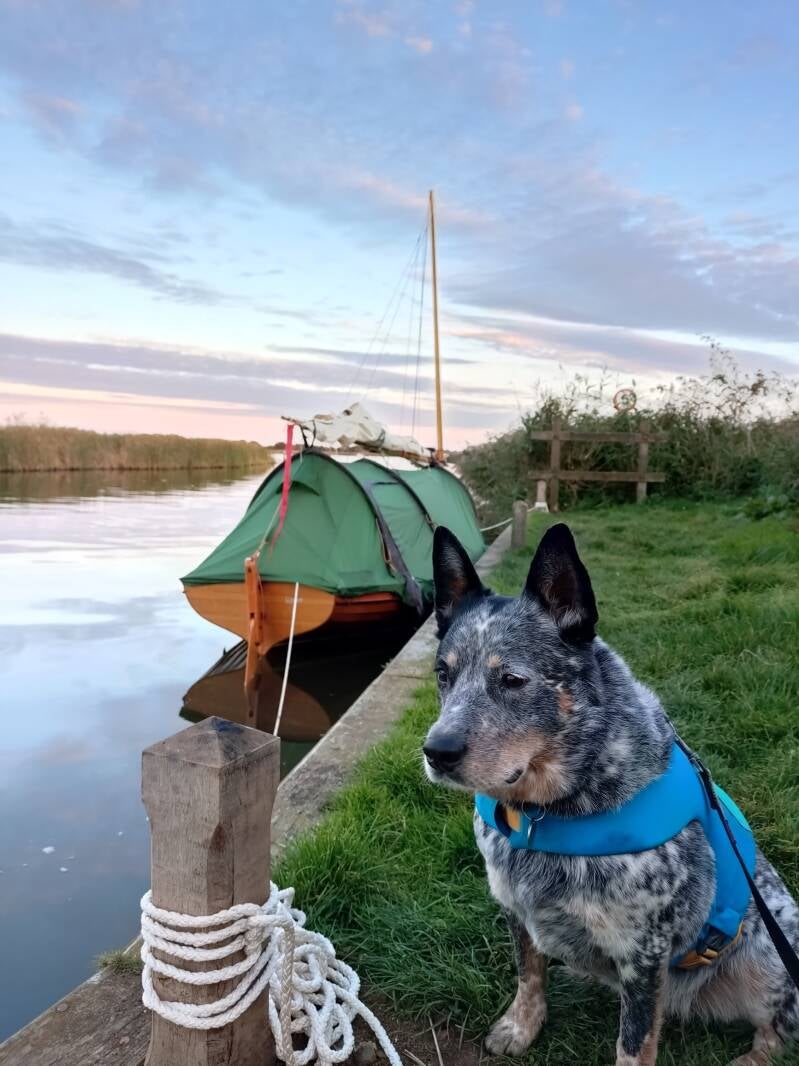
One of the reasons for building Mynewt, was so that I could go on multi-day adventures with our Australian Cattle Dog, Sprout. The plan was to sleep aboard, so after completing the boat building work my next task was to construct a tent to provide some shelter.
Many sailors have constructed tents for dinghy cruising and there are impressive examples shown online in forums. For Mynewt I wanted to maximise the limited space by using a tunnel tent design rather than ‘over-boom’ as I thought I would get better headroom. To maintain space, I also needed to keep the rig out of the boat, so planned to suspend it above the tent using lazy jacks.

The rig held above the fitted tent with lazy jacks
I had limited confidence in my tent-making skills so thought that if I could find a commercial tent with the right footprint and ready-made doors in the right places, my job would be much easier. I was in luck and managed to find one with three hooped poles that I thought could be modified. I can’t say it was easy; the poles were in sleeves on the outer surface of the tent and needed to be diverted to sockets inside the boat, while allowing the material to lie outside over the gunwales. As a result, I found it impossible to get the material wrinkle-free, but I think this is more of an aesthetic issue than a functional one.
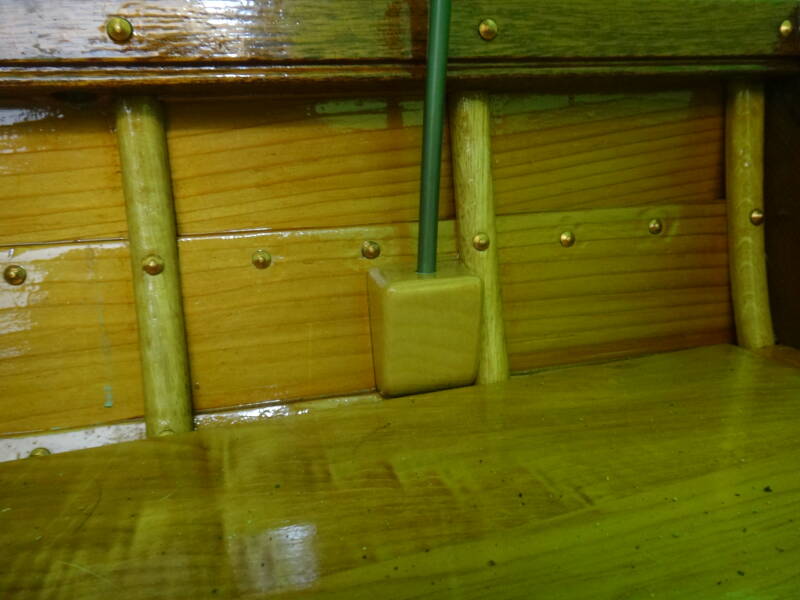
Wooden blocks inside the boat containing sockets for the tent poles.
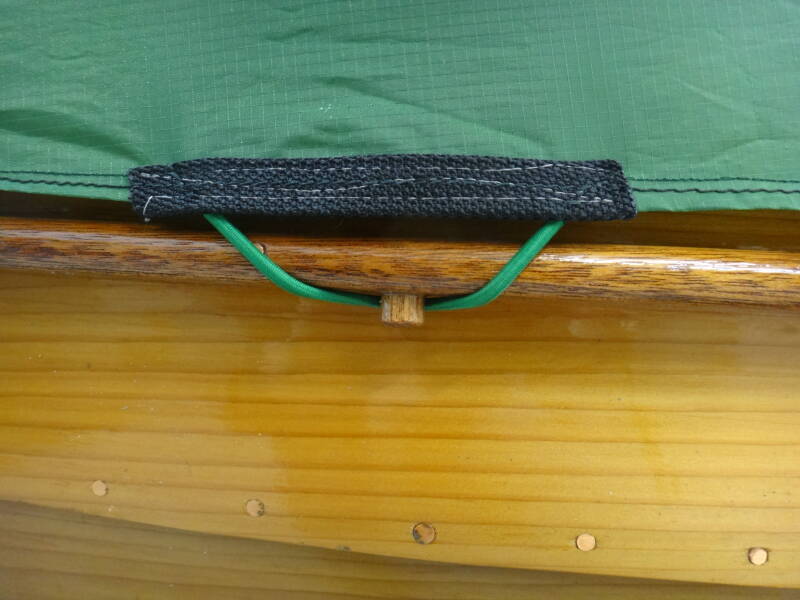
Bungee cord fixed to the bottom of the tent and hooked around dowels below the lower rubrail.
With the poles in place, I trimmed off the excess material and added a series of bungee loops to the lower edges, ready to fit over pieces of wooden dowel screwed underneath the lower rubrails. The split around the mast was lined with neoprene and held with a cord tie, together with Velcro tape – I’ve yet to discover how much it will leak. I doubt if it will be significant and will probably be less of an issue than the inevitable condensation inside modern lightweight tent materials.
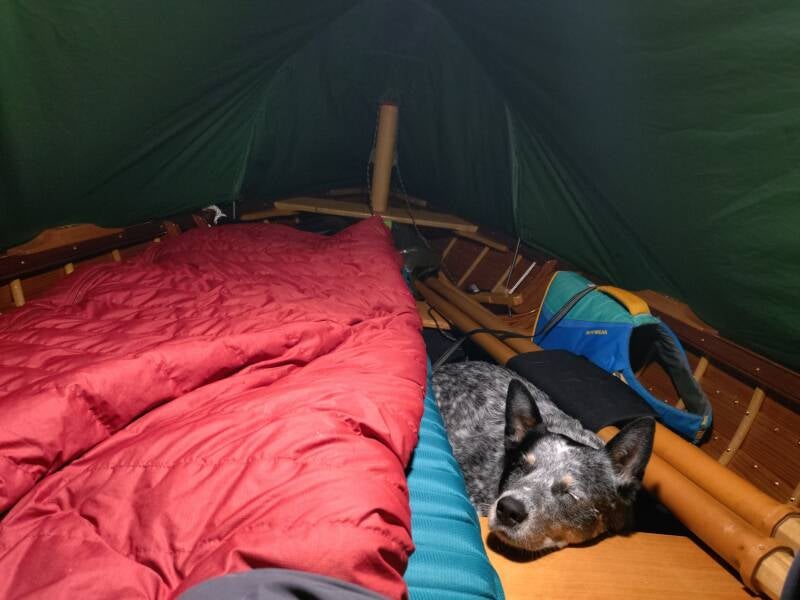
The next issue was how to create a large enough base for my bed, and again I chose a simple commercial option of a camp bed with one of the four legs removed so that it would fit over the main thwart with the head end resting on the stern seat. When covered with an inflated mattress it is remarkably flat and comfortable but takes up a lot of space. Now, with a shelter and sleeping arrangements sorted out, there was no excuse for further delay, and I just had to follow the weather forecasts for a suitable opportunity.
Sailing with Sprout
In preparation for her boating experiences Sprout had been taught two commands: ‘Aboard’ to tell her to leap into the boat, and ‘Land’ to tell her to jump ashore. She responds well to these. However, teaching her the fundamentals of sailing has been met with little success, and I haven’t yet found a suitable Kennel Club registered course. She cannot grasp the purpose of various bits of rope lying about in the boat and will stand in the way of the mainsheet as it swings across on a gybe. Equally, she doesn’t seem to grasp the notion that pressing the tiller sideways alters the course of the boat.
Fortunately, she is extremely agile so can move out of the way quickly if necessary. Her balance is equally impressive, regularly standing with both front paws on the gunwales, surveying the other boats and wildlife.
She has a well-fitting buoyancy aid which she seems to find comfortable, and which has a sturdy handle on the top so she could be pulled out of the water if the worst happens. My view is that she should not be tied to the boat when under way as it could be disastrous in the event of a capsize.
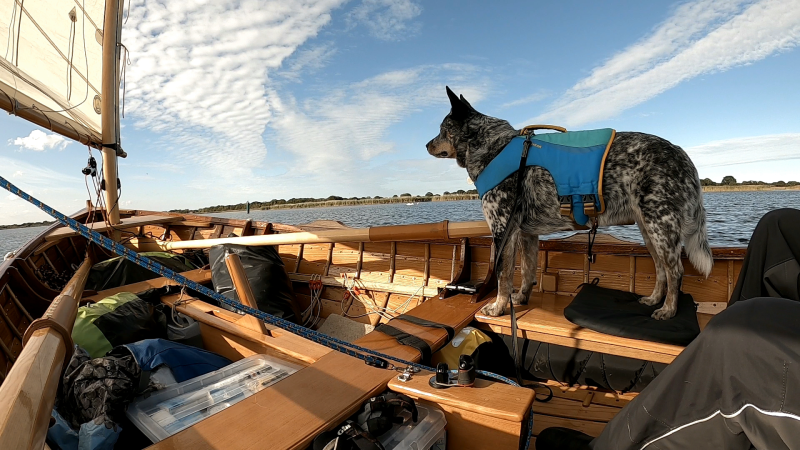
Sailing on Hickling Broad in the Norfolk Broads.
Sprout is, like many dogs, remarkably adaptable and ‘cool’ about accepting new strange circumstances. Sleeping on her bed, squeezed between the centreboard case and the oars, was not an issue and she slept almost immediately. I was concerned that she might wake in the night and creep up to give me a good licking, but she was able to resist that temptation - until I greeted her with ‘Good morning Sprout’.
Right: Quickly asleep in a narrow bed, head on a thwart!
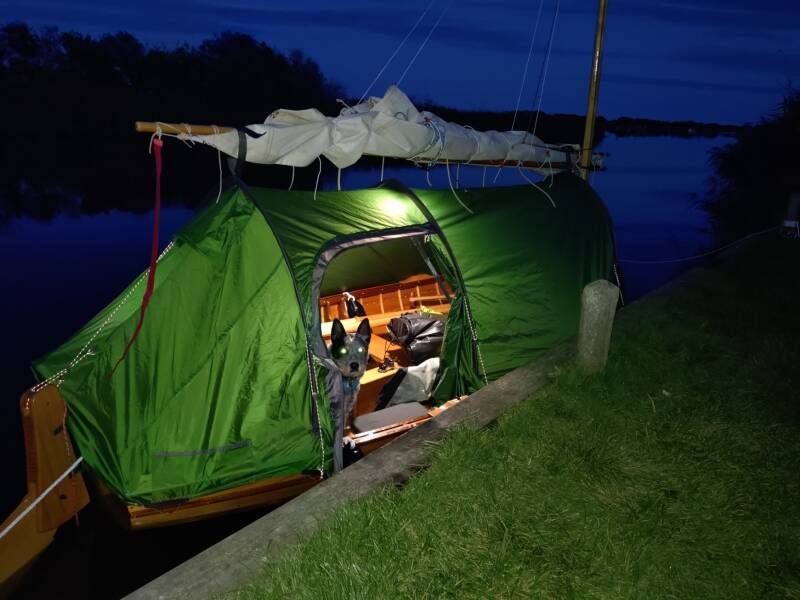
My first trip with Sprout was on the Norfolk Broads and was great fun. Having a canine companion definitely adds to the entertainment even though she did not contribute to the workload. As others may have experienced when sailing on the Broads, the wind always seems to be straight on the nose when on the narrow river sections, so I spent much of the time rowing and pushing Sprout out of the way. When sailing in a good breeze on the Broads themselves, she seemed unconcerned by being keeled over, but her claws have started to add a new patina to my soft cedar seating.
I’m pleased to have achieved my quest of dinghy sailing and camping with Sprout, which was in my mind when I started to build the boat many months ago. I doubt if I will ever spend as much time sailing as I did building, but as both stages are enormous fun, it doesn’t matter. I recommend both.
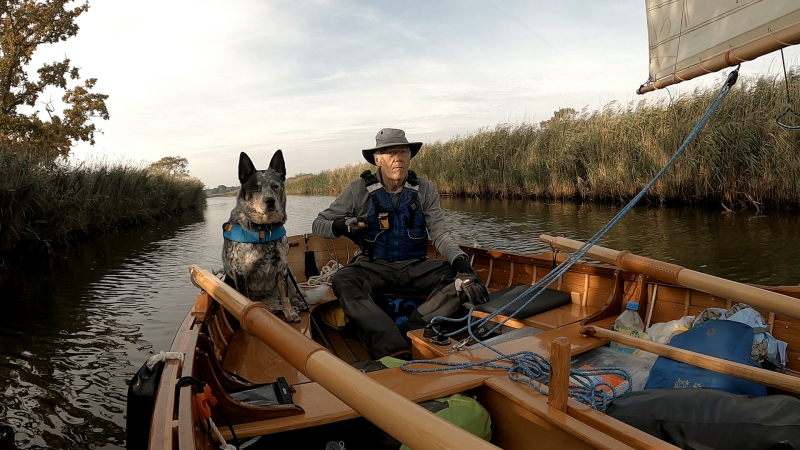
On the way to Horsey Mere.
There is a short video of this first adventure on the Norfolk Broads here: https://youtu.be/KMZA_OlbRfY
Create Your Own Website With Webador